
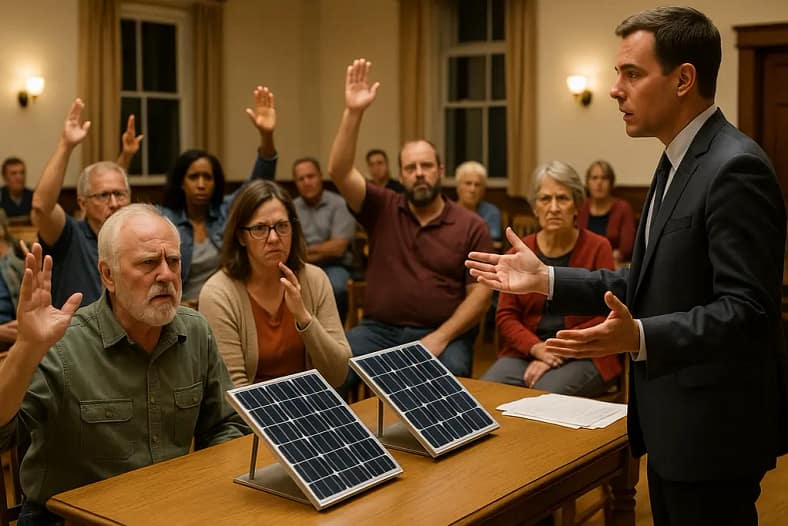
Renewable electricity barriers are often described as engineering problems, but the available evidence points to a wider socio-technical pattern. Grid integration, generation equipment, and storage matter, yet many delays also come from financing conditions, permitting systems, political choices, public acceptance, and supply chains. A cautious analysis has to separate what technology can do from what institutions, markets, and communities are prepared to approve, finance, and maintain.
The research base here is limited to reported evidence on renewable deployment hurdles in several regions, so the claims should not be read as a universal ranking of barriers. The strongest supported finding is narrower: renewable electricity projects can be technically feasible while still facing cost, regulatory, and cultural constraints that slow execution. That distinction matters for content strategy because public communication about clean power often overstates either the ease of deployment or the severity of local opposition.
Why Renewable Electricity Barriers Persist
Renewable Electricity Barriers Are Not Only Technical
Treating renewable electricity barriers as purely technical can obscure the operational conditions required for projects to move from planning to construction. Developers need financing on workable terms, predictable permitting, access to equipment, local consent where required, and grid arrangements that fit the project. If one part of that chain fails, a viable generation technology may still be delayed or cancelled.
The Associated Press reported that the global push to build renewable energy faces hurdles including higher interest rates in Europe and the United States, inflation in materials and construction services, disrupted supply chains, and public resistance in some locations tied to visual and noise concerns AP renewable hurdles. Those factors are not interchangeable. Interest rates affect project finance, inflation changes capital cost assumptions, supply disruption affects delivery schedules, and community concerns affect political and legal risk.
Why Content Framing Needs Evidence
For content teams, the risk is simplifying the problem into a slogan. A renewable project can be cheaper over its operating life but still face high upfront capital needs. A community may support emissions reduction in principle but resist a local installation because of perceived impacts. A regulatory agency may support clean energy goals while still applying slow approval processes. These distinctions help readers understand why deployment speed can fall short of policy targets without implying that the underlying technology has failed.
Cost Pressure And Supply Constraints
Higher Rates Change Project Economics
Renewable electricity projects often require substantial upfront investment before revenue begins. When interest rates rise, the cost of financing those early expenditures increases. The AP reporting cited post-pandemic conditions in Europe and the United States as a source of higher interest rates, which raised upfront expenses for renewable projects. That does not mean every project becomes uneconomic, but it does mean assumptions made under lower-rate conditions may no longer hold.
Inflation creates a related but separate issue. Higher costs for materials and construction services can increase the budget required to build renewable installations. The same reporting noted that decreasing solar panel prices, linked to increased production in China, partly offset some cost pressure. The word “partly” matters. Lower module prices may help solar economics, but they do not erase the cost of labor, interconnection, permitting, land, financing, or other balance-of-system requirements.
Supply Chains Affect Schedules
Supply chain disruption can delay essential components for renewable installations. In practice, schedule risk can raise costs because contractors, grid interconnection windows, financing commitments, and permitting deadlines are often time sensitive. A delayed component is not only a procurement issue; it can affect the sequencing of the full project.
Content that explains clean energy deployment should therefore avoid implying that equipment availability alone determines buildout speed. It is more accurate to describe renewable development as a chain of dependencies. Generation equipment is one part of that chain, but financing terms, construction capacity, regulatory timing, and grid connection all influence whether capacity is delivered on schedule.
Regulation, Permitting, And Public Acceptance
Permitting Can Slow Feasible Projects
Regulatory delay is a central socio-technical issue because it sits between technical readiness and public authorization. Permitting exists for valid reasons, including environmental review, land-use planning, safety, and community consultation. The problem is not regulation itself, but uncertainty, duplication, or slow review processes that make project timelines difficult to plan.
The available research notes also point to cases where insufficient consultation and approval difficulties with local communities have contributed to resistance. Because the cited material available for this article is narrower than the full record on those cases, this point should be stated carefully: community engagement is not a procedural extra. It can determine whether a project earns legitimacy, faces prolonged conflict, or requires redesign.
Aesthetic And Noise Concerns Are Material
Public resistance to renewable installations is sometimes tied to aesthetic and noise concerns. These objections are cultural and local, but they can have technical consequences. Turbine placement, setback distances, transmission routing, and mitigation measures all depend on how project impacts are assessed and negotiated.
For analysts and publishers, this is a reason to avoid dismissive language about local opposition. Some objections may conflict with broader decarbonization goals, but they still affect approval risk and project design. A stronger editorial approach identifies the specific concern, the affected stakeholders, the available mitigation options, and the uncertainty around outcomes.
- Financing: higher interest rates and inflation can raise upfront project costs.
- Procurement: delayed components can disrupt construction schedules.
- Permitting: slow or unclear processes can extend project timelines.
- Community acceptance: visual, noise, land-use, and consultation issues can affect approval.
Political Will And System Planning

Australia Shows A Policy-Centered Barrier
Political will can be as decisive as engineering capacity. In Australia, reporting in The Guardian described a finding that politics was the only barrier to a clean energy system, with no significant technological or economic obstacles identified in that report Australian clean energy politics. The date and context matter: this was a 2017 report, and it should not be treated as a complete assessment of every later grid condition. Still, it supports a broader point that policy alignment can determine whether technically available resources are deployed.
Political barriers can appear in several forms: inconsistent targets, slow market reform, uncertainty over incentives, weak planning for transmission, or conflict between national and local priorities. The research provided does not quantify each factor, so it would be inaccurate to rank them here. What can be said is that renewable electricity barriers often come from governance decisions as much as from engineering limits.
Energy Demand Adds Planning Pressure
Rising electricity demand can complicate the timing of clean power deployment. The research notes refer to data center growth associated with artificial intelligence as a source of increased power demand, with some utilities responding through new fossil-fuel generation. Because the high-authority source allowed for this article does not include that specific reporting link, this point should be treated as contextual rather than a cited finding here.
Even with that limitation, the planning issue is clear at a general level: renewable buildout has to be assessed against demand growth, grid capacity, and reliability requirements. Technical readers who follow computing infrastructure and energy systems may find related context at a site like CampTechWise, which covers intersections of digital infrastructure and power planning discussions.
Renewable Electricity Barriers For Energy Content Strategy
For content teams, renewable electricity barriers should be framed as linked operational constraints, not as a single cause. The most defensible structure is to separate cost, permitting, public acceptance, supply chain risk, and political decision-making. Each category should be tied to sourced evidence, with clear language about what is known and what remains uncertain.
This approach also improves reader trust. A piece that says renewable deployment is “blocked by politics” may be accurate in one jurisdiction and incomplete in another. A piece that says “technology is ready” may overlook financing, consultation, or construction limits. Evidence-based communication should show how a project moves through finance, procurement, approval, construction, and grid connection, then identify where delays occur.
The most useful editorial stance is cautious specificity. Renewable electricity can expand under supportive cost, policy, and community conditions, but those conditions are not automatic. By naming the actual barriers and avoiding unsupported claims, publishers can give policymakers, developers, and affected communities a clearer basis for debate.