
Day: August 16, 2026

Renewable Electricity Barriers: Social And Policy

Renewable electricity barriers are often described as engineering problems, but the available evidence points to a wider socio-technical pattern. Grid integration, generation equipment, and storage matter, yet many delays also come from financing conditions, permitting systems, political choices, public acceptance, and supply chains. A cautious analysis has to separate what technology can do from what institutions, markets, and communities are prepared to approve, finance, and maintain.

The research base here is limited to reported evidence on renewable deployment hurdles in several regions, so the claims should not be read as a universal ranking of barriers. The strongest supported finding is narrower: renewable electricity projects can be technically feasible while still facing cost, regulatory, and cultural constraints that slow execution. That distinction matters for content strategy because public communication about clean power often overstates either the ease of deployment or the severity of local opposition.

Why Renewable Electricity Barriers Persist

Renewable Electricity Barriers Are Not Only Technical

Treating renewable electricity barriers as purely technical can obscure the operational conditions required for projects to move from planning to construction. Developers need financing on workable terms, predictable permitting, access to equipment, local consent where required, and grid arrangements that fit the project. If one part of that chain fails, a viable generation technology may still be delayed or cancelled.

The Associated Press reported that the global push to build renewable energy faces hurdles including higher interest rates in Europe and the United States, inflation in materials and construction services, disrupted supply chains, and public resistance in some locations tied to visual and noise concerns AP renewable hurdles. Those factors are not interchangeable. Interest rates affect project finance, inflation changes capital cost assumptions, supply disruption affects delivery schedules, and community concerns affect political and legal risk.

Why Content Framing Needs Evidence

For content teams, the risk is simplifying the problem into a slogan. A renewable project can be cheaper over its operating life but still face high upfront capital needs. A community may support emissions reduction in principle but resist a local installation because of perceived impacts. A regulatory agency may support clean energy goals while still applying slow approval processes. These distinctions help readers understand why deployment speed can fall short of policy targets without implying that the underlying technology has failed.

Cost Pressure And Supply Constraints

Higher Rates Change Project Economics

Renewable electricity projects often require substantial upfront investment before revenue begins. When interest rates rise, the cost of financing those early expenditures increases. The AP reporting cited post-pandemic conditions in Europe and the United States as a source of higher interest rates, which raised upfront expenses for renewable projects. That does not mean every project becomes uneconomic, but it does mean assumptions made under lower-rate conditions may no longer hold.

Inflation creates a related but separate issue. Higher costs for materials and construction services can increase the budget required to build renewable installations. The same reporting noted that decreasing solar panel prices, linked to increased production in China, partly offset some cost pressure. The word “partly” matters. Lower module prices may help solar economics, but they do not erase the cost of labor, interconnection, permitting, land, financing, or other balance-of-system requirements.

Supply Chains Affect Schedules

Supply chain disruption can delay essential components for renewable installations. In practice, schedule risk can raise costs because contractors, grid interconnection windows, financing commitments, and permitting deadlines are often time sensitive. A delayed component is not only a procurement issue; it can affect the sequencing of the full project.

Content that explains clean energy deployment should therefore avoid implying that equipment availability alone determines buildout speed. It is more accurate to describe renewable development as a chain of dependencies. Generation equipment is one part of that chain, but financing terms, construction capacity, regulatory timing, and grid connection all influence whether capacity is delivered on schedule.

Regulation, Permitting, And Public Acceptance

Permitting Can Slow Feasible Projects

Regulatory delay is a central socio-technical issue because it sits between technical readiness and public authorization. Permitting exists for valid reasons, including environmental review, land-use planning, safety, and community consultation. The problem is not regulation itself, but uncertainty, duplication, or slow review processes that make project timelines difficult to plan.

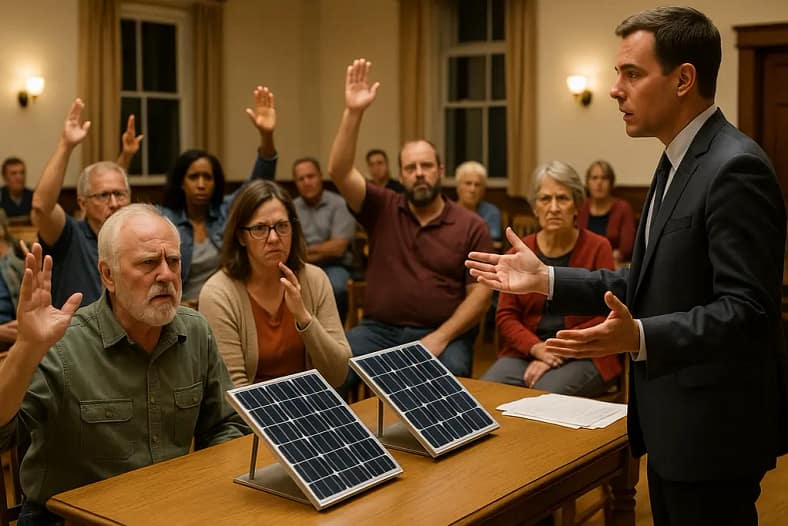
The available research notes also point to cases where insufficient consultation and approval difficulties with local communities have contributed to resistance. Because the cited material available for this article is narrower than the full record on those cases, this point should be stated carefully: community engagement is not a procedural extra. It can determine whether a project earns legitimacy, faces prolonged conflict, or requires redesign.

Aesthetic And Noise Concerns Are Material

Public resistance to renewable installations is sometimes tied to aesthetic and noise concerns. These objections are cultural and local, but they can have technical consequences. Turbine placement, setback distances, transmission routing, and mitigation measures all depend on how project impacts are assessed and negotiated.

For analysts and publishers, this is a reason to avoid dismissive language about local opposition. Some objections may conflict with broader decarbonization goals, but they still affect approval risk and project design. A stronger editorial approach identifies the specific concern, the affected stakeholders, the available mitigation options, and the uncertainty around outcomes.

  • Financing: higher interest rates and inflation can raise upfront project costs.
  • Procurement: delayed components can disrupt construction schedules.
  • Permitting: slow or unclear processes can extend project timelines.
  • Community acceptance: visual, noise, land-use, and consultation issues can affect approval.

Political Will And System Planning

Transmission towers crossing open land under a cloudy sky

Australia Shows A Policy-Centered Barrier

Political will can be as decisive as engineering capacity. In Australia, reporting in The Guardian described a finding that politics was the only barrier to a clean energy system, with no significant technological or economic obstacles identified in that report Australian clean energy politics. The date and context matter: this was a 2017 report, and it should not be treated as a complete assessment of every later grid condition. Still, it supports a broader point that policy alignment can determine whether technically available resources are deployed.

Political barriers can appear in several forms: inconsistent targets, slow market reform, uncertainty over incentives, weak planning for transmission, or conflict between national and local priorities. The research provided does not quantify each factor, so it would be inaccurate to rank them here. What can be said is that renewable electricity barriers often come from governance decisions as much as from engineering limits.

Energy Demand Adds Planning Pressure

Rising electricity demand can complicate the timing of clean power deployment. The research notes refer to data center growth associated with artificial intelligence as a source of increased power demand, with some utilities responding through new fossil-fuel generation. Because the high-authority source allowed for this article does not include that specific reporting link, this point should be treated as contextual rather than a cited finding here.

Even with that limitation, the planning issue is clear at a general level: renewable buildout has to be assessed against demand growth, grid capacity, and reliability requirements. Technical readers who follow computing infrastructure and energy systems may find related context at a site like CampTechWise, which covers intersections of digital infrastructure and power planning discussions.

Renewable Electricity Barriers For Energy Content Strategy

For content teams, renewable electricity barriers should be framed as linked operational constraints, not as a single cause. The most defensible structure is to separate cost, permitting, public acceptance, supply chain risk, and political decision-making. Each category should be tied to sourced evidence, with clear language about what is known and what remains uncertain.

This approach also improves reader trust. A piece that says renewable deployment is “blocked by politics” may be accurate in one jurisdiction and incomplete in another. A piece that says “technology is ready” may overlook financing, consultation, or construction limits. Evidence-based communication should show how a project moves through finance, procurement, approval, construction, and grid connection, then identify where delays occur.

The most useful editorial stance is cautious specificity. Renewable electricity can expand under supportive cost, policy, and community conditions, but those conditions are not automatic. By naming the actual barriers and avoiding unsupported claims, publishers can give policymakers, developers, and affected communities a clearer basis for debate.


Microgrid Implementation Costs And Risks

Microgrid implementation can improve local energy resilience in some settings, but the business case is rarely simple. The research base points to high upfront capital costs, project-specific financial modeling, uncertain legal treatment, technical integration issues, and security exposure as recurring constraints. For businesses, public agencies, and facility owners, the core question is not whether microgrids are useful in theory. It is whether a specific system can be financed, permitted, operated, protected, and maintained under local conditions.

A microgrid project usually combines generation, storage, power electronics, controls, communications, and connection equipment into a single operating system. That combination is the source of both value and difficulty. Hardware choices affect control strategy. Control strategy affects reliability. Local rules affect ownership and interconnection. Weather and load patterns affect the financial model. Because these dependencies vary by site, project teams should avoid generic cost assumptions unless they are clearly labeled as early estimates.

Why Microgrid Implementation Is Hard To Finance

Capital Costs Start Before The System Operates

High initial capital cost is one of the clearest barriers identified in the research. A functioning system can require solar panels, battery storage units, inverters, advanced control software, engineering work, and permitting activity. MarketDataForecast identifies significant hardware and project development investment as a cost constraint for the U.S. market in its U.S. microgrid market report. That matters because the largest cash requirements often occur before the owner receives operational benefits from the system.

The financing challenge is not limited to the equipment invoice. Engineering design, site studies, utility coordination, legal review, and permitting can all affect the development budget. These items are difficult to standardize because the system must fit a specific electrical load and local connection environment. A hospital, campus, industrial site, remote community, or municipal facility may require different reliability targets, load priorities, generation mixes, and operating agreements.

Microgrid Implementation And Project-Specific Risk

The Center for Climate and Energy Solutions notes that each project can include different electric generation types and sizes, serve a unique load, sit in a unique geography and market, and face different weather variability and regulations through its microgrids explainer. This is a practical warning for financial teams. A model copied from another site may miss load behavior, tariff exposure, resource variability, or local regulatory limits.

Microgrid implementation therefore needs scenario analysis rather than a single optimistic forecast. Project sponsors should test how the business case changes if storage requirements increase, permitting takes longer, load growth differs from expectations, or grid-service revenue is unavailable. The research does not support one universal cost threshold or payback period. It supports a more cautious position: financial viability depends on site-level design, local rules, available technologies, and the value placed on resilience.

Regulatory And Stakeholder Constraints Increase Uncertainty

Legal Definitions Are Not Consistent

Regulation is a major source of uncertainty because legal treatment can differ between and within states. The research states that virtually all states lack even a legal definition of a microgrid. Without a consistent definition, project teams may face unclear treatment around ownership, utility interaction, power sales, islanding operation, and customer relationships. These are not minor administrative details; they can shape whether a proposed system is practical under current rules.

Legal uncertainty also affects investor confidence. If the project depends on operating in both grid-tied and autonomous modes, the rules governing that operation need to be clear before major capital is committed. Where regulations are unsettled, sponsors may need longer development schedules and more legal review. That raises soft costs and can make smaller projects harder to justify.

Multiple Stakeholders Complicate The Operating Model

Microgrids tend to integrate multiple energy technologies and unique circumstances into one project. That creates coordination work across facility owners, utilities, technology vendors, financiers, regulators, emergency planners, and operations staff. Each stakeholder may evaluate success differently. A facility operator may prioritize continuity of critical loads. A utility may focus on safe interconnection and grid stability. A financier may focus on repayment certainty and contract enforceability.

This coordination burden can slow decisions even when the technical concept is sound. Project governance should specify who owns assets, who dispatches resources, who maintains equipment, who approves islanding events, and who carries performance risk. If those responsibilities are left vague, the project can encounter friction during procurement, commissioning, or emergency operation.

Technical Challenges Extend Beyond Hardware Selection

Control During Grid-Tied And Autonomous Operation

A microgrid must be able to coordinate generation, storage, and load under changing conditions. The research identifies power imbalance during the changeover from grid-tied mode to autonomous mode as a technical issue. The risk is intuitive: when the system changes from relying on the broader grid to operating independently, supply and demand must remain balanced. If the microgrid is acting as a sink or source at the time of transition, the control system has to manage that shift without destabilizing the local network.

This makes control software, inverter behavior, protection settings, and operational testing central to microgrid implementation. Procurement teams sometimes focus on visible assets such as panels and batteries, but the control layer determines whether those assets behave as a coordinated electrical system. A design that looks attractive in a planning document still needs commissioning, testing, staff training, and maintenance routines.

Standardization Limits Comparability

The research also identifies a lack of standardization. Existing approaches can treat every project as a unique system, which leads to expensive, non-standardized implementations that are difficult to compare. This is a barrier for both buyers and investors. If project structures, component specifications, control methods, and performance metrics differ significantly, it becomes harder to benchmark cost, reliability, and operational value across deployments.

Standardization does not mean every system should be identical. It means recurring design patterns, comparable documentation, and clear performance criteria can reduce ambiguity. Without those elements, due diligence takes longer, vendor comparisons are less direct, and lessons from one project may transfer poorly to the next.

Cybersecurity And Maintenance Need Early Attention

Technician checking secure network equipment connected to energy controls

Connected Energy Systems Expand The Security Surface

The research notes that as microgrids become more common, they are increasingly vulnerable to cyber-attacks and may need cybersecurity measures designed specifically for microgrid environments. That concern should be treated as part of system design, not as a later IT add-on. Controls, communications, remote monitoring, and vendor access can all introduce security requirements that differ from conventional office technology.

Security planning should include asset inventory, access control, update management, logging, backup procedures, and incident response roles. General consumer security resources such as a related site in the same network can help non-specialists understand baseline protection concepts, but industrial and energy systems require engineering review, operational constraints, and vendor-specific controls. Defensive planning is especially important because microgrids may support critical loads during grid outages.

Operations Costs Can Be Underestimated

Maintenance is another area where early models can be too narrow. A project budget that covers equipment purchase but underestimates inspections, software support, battery management, testing, spare parts, and operator training may create problems after commissioning. The research does not provide a single maintenance cost ratio, so teams should be transparent about uncertainty and document assumptions rather than presenting unsupported precision.

The same caution applies to energy storage. The research identifies storage cost as a major barrier, but specific prices vary by chemistry, supplier, configuration, warranty, safety requirements, and installation conditions. A cautious model should separate storage procurement, integration, enclosure or site preparation, controls, replacement planning, and end-of-life handling where relevant.

Microgrid Implementation Choices For Project Teams

Evidence Should Drive Scope Before Procurement

A defensible microgrid implementation plan starts with load analysis, resilience requirements, regulatory review, and stakeholder roles before vendor selection. Teams should define which loads are critical, how long those loads must operate during an outage, what generation and storage resources are allowed at the site, and what interconnection terms are available. These inputs shape the system far more than a generic equipment list.

Financial planning should distinguish between resilience value, energy cost management, and any expected market participation. If the project cannot assign a credible value to resilience, the business case may appear weaker than the operational need suggests. If it assumes revenue or savings that depend on uncertain rules, the model should show that dependency clearly.

Microgrid Implementation Requires Ongoing Governance

Microgrid implementation is not finished when construction ends. The system must be tested, maintained, updated, and reviewed as loads, tariffs, technologies, and regulations change. Owners should assign responsibility for operational decisions, cybersecurity controls, vendor management, compliance documentation, and periodic performance review. That governance structure reduces the risk that a technically capable system becomes difficult to operate safely or economically.

The evidence supports a cautious but constructive view. Microgrids can address specific resilience and energy-management needs, yet they bring site-specific cost, legal, control, standardization, and security challenges. The strongest projects are likely to be the ones that define those constraints early, quantify uncertainty honestly, and treat engineering, finance, regulation, and operations as connected parts of the same decision.