
Day: August 14, 2026

Power Sector AI: Data Quality And Training Gaps

Power Sector AI is often discussed as a way to improve forecasting, grid optimization, and operational decision support. The evidence available in the research notes points to a more restrained reading: adoption is slowed by data quality, limited workforce training, talent scarcity, legacy control systems, regulatory uncertainty, and data protection concerns. Those barriers are not abstract. They affect whether a model can receive usable input, whether operators understand its output, and whether the system can be governed safely.

From an SEO case-study lens, the useful lesson is operational rather than promotional. A system cannot produce reliable outputs from fragmented inputs, and a team cannot maintain technical quality without the skills to inspect the pipeline. That same principle appears in search publishing, where crawlable structure and evidence quality still matter; a related WayLatino analysis of AI search SEO fundamentals makes a similar point for website visibility. In the power sector, the stakes are different, but the quality-control logic is familiar.

Why Power Sector AI Adoption Stalls In Practice

Power Sector AI Depends On Comparable Grid Data

The research notes identify inconsistent data formats and limited data availability across utilities, independent system operators, and regional transmission organizations as barriers to broad analysis and implementation. Columbia’s Center on Global Energy Policy describes these data issues and also notes that useful AI work requires knowledge of both the electric grid and AI technologies in its power-sector AI analysis. That pairing matters because model development and grid operations are not separate worlds once a system is proposed for real operational support.

Power Sector AI projects can fail before model selection if the data layer is inconsistent. A forecasting model, anomaly detector, or optimization tool needs data that can be compared across time, assets, and regions. If one utility stores operational records in one format and another uses a different structure, the implementation team must first resolve definitions, timestamps, missing fields, and access permissions. The research notes do not provide a quantified failure rate or a deployment benchmark, so the safest finding is qualitative: fragmented and inconsistent data make adoption harder and slower.

Training Gaps Create Operational Risk

The second barrier is human capability. The notes describe a lack of AI training among energy-sector employees as a major obstacle. This is not only a hiring issue. Grid operators, engineers, compliance teams, and managers need enough shared language to challenge outputs, interpret uncertainty, and decide where automation is inappropriate. If the workforce treats model output as either magic or noise, neither response supports reliable deployment.

For Power Sector AI, training has to cover both directions. Data teams need enough power-system context to avoid naive features, weak labels, and irrelevant benchmarks. Operations teams need enough AI literacy to understand model limits, false positives, data drift, and monitoring requirements. The available research supports that combined skill requirement, but it does not show that a single training format solves it. Any adoption program should treat training as an ongoing operating cost, not a one-time workshop.

Data Quality Is A Technical And Institutional Barrier

Format Differences Limit Model Readiness

Data quality in this context is not just accuracy. It includes format consistency, field definitions, latency, access rights, and coverage across assets. In power systems, the same physical event can be represented differently depending on the source system, the utility, or the market operator. That makes model-ready data preparation a governance task as much as an engineering task.

A cautious adoption path would start with a narrow inventory: which data sources exist, who owns them, how frequently they update, and where missing or incompatible fields appear. Without that inventory, teams may overstate the maturity of their AI program. The research notes support the existence of inconsistent formats and availability barriers, but they do not specify which regions, utilities, or system types are most affected. That uncertainty should be stated in any case study or vendor review.

Legacy Systems Slow Integration

Legacy Supervisory Control and Data Acquisition systems are another constraint identified in the research notes. Alice Labs describes long asset lifecycles, proprietary protocols, and compatibility issues between older SCADA environments and modern machine-learning pipelines in its energy AI review. That does not mean every legacy system blocks AI. It means integration cost and maintenance risk can be material, especially where systems were not designed for high-volume analytics workflows.

Power Sector AI also depends on reliable interfaces between operational technology and information technology. A model that works in a lab may require extra data connectors, validation layers, access controls, and monitoring before it can support production decisions. The research notes do not provide cost ranges for integration. A careful technical review should avoid invented budgets and instead document known system dependencies, protocol constraints, and maintenance ownership.

Workforce Training Determines Safe AI Use

Domain Knowledge Cannot Be Replaced By Models

The research points to a shortage of machine-learning engineers with energy-domain expertise. That shortage is plausible as a barrier because electric-grid data is specialized, operationally sensitive, and tied to physical constraints. A general machine-learning workflow may not capture the difference between an irrelevant correlation and a signal that matters for reliability, safety, or regulatory reporting.

The same problem appears from the other side. Experienced grid staff may understand system behavior but lack the training to evaluate model confidence, distribution shift, feature leakage, or retraining schedules. In a practical adoption plan, these groups need joint review processes. The goal is not to turn every operator into a data scientist. The goal is to make sure no model is accepted without informed technical and operational review.

Talent Scarcity Raises Maintenance Costs

Talent scarcity affects more than initial implementation. AI systems require monitoring after deployment because input data can change, asset conditions can change, and workflows can drift from their original design. If an energy organization lacks staff who understand both the grid and the model pipeline, it may struggle to detect degrading performance or to update the system without creating new risk.

  • Confirm which data fields are available, consistent, and governed before model development starts.
  • Define who can approve model use in operational workflows and who can stop it.
  • Train grid staff on model limits, not just dashboards and output screens.
  • Assign maintenance ownership for data pipelines, model monitoring, and access controls.

These steps are basic, but they are often where adoption becomes realistic. The research does not show that a specific training program or staffing model is sufficient across all utilities. That limitation matters. A utility with modern data infrastructure and internal AI staff faces a different adoption path than a smaller organization with older systems and limited analytics capacity.

Security, Regulation, And Energy Use Limits

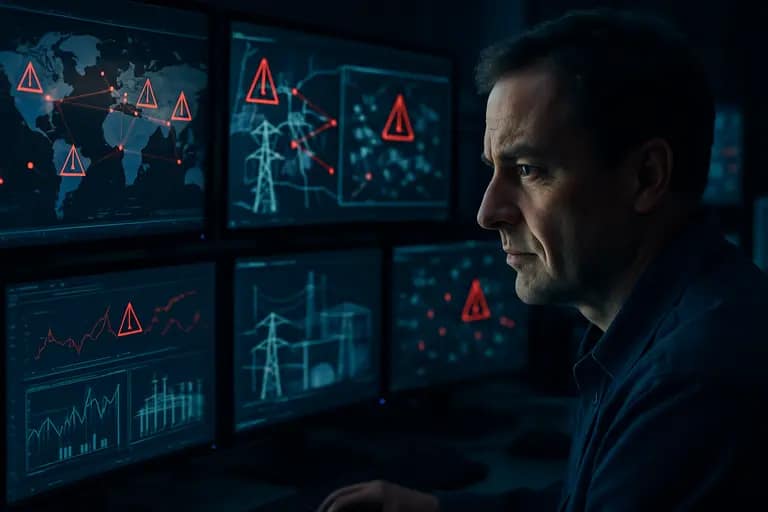
Control room workstation with cybersecurity and grid monitoring panels

Automated Control Needs Clear Guardrails

The research notes identify unclear regulation around automated grid control as a barrier. That is a material constraint because AI in the power sector can range from advisory analytics to systems that influence operational decisions. The risk profile changes depending on where the system sits. A demand forecast used for planning is not the same as automation connected to control actions.

Regulatory uncertainty can slow adoption even when a technical proof of concept looks promising. Utilities and system operators need to know what decisions can be automated, what must remain under human review, how accountability is assigned, and how audit trails should be preserved. The available research does not define the exact regulatory rules at issue, so this analysis should not claim a specific legal barrier beyond the documented uncertainty.

Trust Depends On Data Protection

Data privacy and security concerns also affect adoption. AI systems may need access to operational data, customer-related data, vendor systems, or market information. Each additional data flow can create questions about access rights, retention, monitoring, and breach exposure. Defensive controls are part of implementation readiness, not an optional layer added after a model performs well in testing.

Energy use creates a separate tension. The research notes state that AI data centers are consuming increasing amounts of energy and can strain grid capacity. That fact does not prove that every AI tool used by utilities creates a large demand burden. It does mean energy organizations should distinguish between using AI to support grid operations and the broader load growth associated with AI infrastructure. Readers comparing infrastructure-heavy technology coverage across sectors may also find insights at Abacus News.

Power Sector AI Adoption Requires Evidence Discipline

What Teams Can Measure Before Scaling

Power Sector AI adoption should be evaluated through inputs, controls, and maintenance capacity before broad claims are made about benefits. The supported evidence here points to barriers in data quality, workforce training, AI talent, legacy systems, regulation, and security. It does not provide verified performance improvements, cost savings, or deployment rates. A cautious case study should keep that distinction visible.

Before scaling a project, teams can document whether source data is consistent, whether operators have been trained on model limits, whether legacy systems can be integrated without fragile workarounds, whether security controls are defined, and whether regulatory responsibilities are clear. That evidence-first approach will not make adoption simple. It can prevent organizations from confusing a promising demonstration with a maintainable production system.


DER Integration and Interconnection Reform

DER integration is less constrained by a single technology gap than by the rules, queues, cost signals, and planning practices that decide whether distributed assets can connect without creating avoidable risk or expense. Distributed energy resources can include assets located near customers or distribution systems, but the policy problem is not only where they sit. The harder question is how interconnection review, grid upgrade funding, and compensation frameworks align with reliability needs and the pace of project applications.

The available research points to a practical tension. More interconnection requests can expose limits in manual review workflows, utility hosting capacity analysis, and cost assignment methods. At the same time, regulators must avoid reforms that shift costs unfairly or weaken safety review. A careful content strategy for this topic should not present faster approval as the only goal. The more defensible frame is process quality: transparent data, consistent steps, fair cost allocation, and better links between interconnection studies and distribution planning.

Why DER Integration Strains Current Rules

DER Integration Meets Older Review Processes

Many interconnection procedures were designed for a lower volume of applications and for simpler operating assumptions. As more distributed projects request connection, queues can lengthen, and the review process can become a cost driver before equipment is installed. The U.S. Department of Energy released its Distributed Energy Resource Interconnection Roadmap in January 2025, identifying issues such as queue management, process improvement, and support for under-resourced customers as areas needing attention in interconnection reform DOE interconnection roadmap.

This does not mean every delay is wasteful. Some studies are needed to evaluate protection settings, voltage impacts, equipment limits, operational coordination, and safety. The misalignment occurs when review steps are unclear, duplicated, regionally inconsistent, or disconnected from known grid constraints. In those cases, a project may spend time and money waiting for information that could have been available earlier through clearer data access or better screening methods.

Cost Signals Can Be Too Narrow

Cost allocation is one of the most difficult regulatory questions. A strict cost-causer-pays approach can appear administratively simple, but it may assign a large upgrade cost to the project that happens to trigger a study threshold, even when later projects or the broader system benefit from the same upgrade. The DOE roadmap identifies equitable cost allocation and the relationship between interconnection and grid planning as reform needs, reflecting concern that system-level upgrades can be handled in a piecemeal manner rather than through coordinated planning.

That point matters for DER integration because cost uncertainty can stop otherwise viable projects, especially smaller developers, public agencies, small businesses, or communities with fewer technical and legal resources. A reform that spreads costs too broadly may be unfair to customers who do not benefit. A reform that places upgrade costs too narrowly may discourage projects that could provide local value. The policy challenge is to define beneficiaries with enough precision to be defensible, while keeping the process understandable and timely.

Regulatory Innovation Needs Better Alignment

Compensation And Cost Allocation Must Be Linked

Regulatory treatment of distributed resources often separates compensation from interconnection cost assignment. That separation can create distorted incentives. If a resource is paid for certain grid or customer benefits but charged for upgrades under a different logic, developers and customers may receive mixed signals. Lawrence Berkeley National Laboratory has described the need for a Distributed Energy Resource Integration Framework focused on regulatory innovation for DER compensation and cost allocation LBNL DER framework.

The useful takeaway is not that a single rate design will fit every jurisdiction. Distribution systems differ, customer mixes differ, and state regulatory authority varies. The supported claim is narrower: DER integration requires compensation and cost allocation methods that are precise enough to reflect costs and benefits without creating avoidable administrative burden. That precision is hard to achieve when interconnection decisions are made project by project while planning assumptions are updated on a different schedule.

Standardization Should Not Remove Local Engineering Judgment

Standardization can reduce confusion for applicants and utility staff. Common application data, clearer study screens, defined timelines, and repeatable queue rules can make outcomes easier to compare. Yet standardization should not be confused with automatic approval. Local feeder conditions, existing equipment, protection schemes, and operating practices still matter. A standard process can define the path; engineering review still determines whether a specific connection is safe and reliable.

For content teams explaining this issue, the distinction is worth making explicit. DER integration policy is not a contest between regulation and innovation. It is a control problem across institutions: regulators set incentives and obligations, utilities assess system conditions, developers submit project data, and customers absorb some mix of costs and benefits. For those seeking classroom-focused materials, a site connected within the same network, Stamps in Class, offers educational resources that translate complex policy topics for teaching environments.

Interconnection Process Design And Risk Controls

Engineer reviewing grid control data and distribution equipment diagrams

Automation Can Help, But Data Quality Sets The Limit

Queue management and automation are often discussed as remedies for delayed interconnection. They can help if they reduce repeated manual work, improve status visibility, and apply screening criteria consistently. Their value depends on accurate system models, current hosting capacity information, well-defined application requirements, and staff capacity to resolve exceptions. Automation built on incomplete data may only process weak assumptions faster.

A cautious implementation path would separate low-risk screening from cases that need deeper study. For example, projects with limited impacts under defined technical screens may move through faster review, while projects that trigger equipment constraints or protection questions require additional analysis. The research provided does not support a universal timeline target or a universal cost reduction figure, so claims about speed or savings should be avoided unless tied to a specific program with published results.

Cybersecurity And Operations Cannot Be Treated As Afterthoughts

As distributed assets increase in number, communications, monitoring, and control interfaces become more significant. The research notes cybersecurity concerns, but it does not provide a specific threat model, incident record, or technical standard that can be cited here. The defensible statement is that interconnection reform should include operational and security review where DER controls, aggregators, utility systems, or remote management functions interact.

Security requirements should be proportionate. Overly broad requirements can raise costs for small projects without reducing meaningful risk. Weak requirements can create exposure in systems that support grid operations. The practical content angle is to ask what data flows, what control permissions exist, who maintains devices, how updates are handled, and how utilities and applicants document responsibilities after interconnection approval.

  • Applicants need clear requirements, status visibility, and predictable review paths.
  • Utilities need accurate project data, planning tools, and authority to protect reliability.
  • Regulators need transparent cost allocation records and measurable process outcomes.
  • Customers need protection from unfair cost shifts and avoidable project delays.

DER Integration Policy Priorities For Practical Reform

DER integration policy should focus on the points where technical review and regulatory design meet. The first priority is queue discipline: complete applications, clear milestones, transparent withdrawal rules, and status reporting that reduces uncertainty. The second is planning coordination, so upgrades identified through interconnection are not treated only as isolated project expenses when broader system use is likely. The third is cost allocation that distinguishes direct project impacts from shared network benefits.

Support for under-resourced customers also deserves attention. Interconnection procedures can be difficult for small businesses, local governments, and community organizations that lack dedicated energy staff. Assistance does not need to weaken technical standards. It can mean clearer forms, plain-language process maps, predictable study fees, and access to pre-application information where allowed.

The most credible reform agenda is neither deregulatory nor process-heavy for its own sake. It is evidence-based administration: define the technical screens, publish the steps, align compensation with cost responsibility, improve data used for studies, and track whether changes reduce avoidable delay without shifting costs unfairly. That is the standard by which DER integration proposals should be assessed.

Smart Grid Adoption Barriers for U.S. Utilities

Smart Grid Adoption in U.S. utilities is less a single technology upgrade than a coordinated change to meters, communication networks, control systems, cybersecurity practices, customer operations, and regulatory cost recovery. The case evidence supplied for this study points to a consistent pattern: utilities see operational value in digital grid functions, but the first wave of spending, integration risk, and uncertain payback make adoption slower and more selective than policy language often suggests.

The obstacles are not evenly distributed. Large investor-owned utilities may be better positioned to fund multiyear programs, while smaller municipal utilities and cooperatives can face sharper budget limits. The same technical concept can also carry different risk depending on system age, staff capability, vendor mix, state oversight, and the number of distributed energy resources already attached to the grid.

Why Smart Grid Adoption Stalls At Utilities

Smart Grid Adoption Requires Measurable Reliability

Utilities operate under a conservative engineering mandate: keep power flowing safely and restore service quickly when faults occur. That operating culture does not reject digital systems, but it does raise the proof threshold for new devices, communication layers, and automated controls. Research notes for this case identify perceived immaturity of some technologies as one reason utilities delay broad deployment. The word “perceived” matters because it signals a judgment about reliability, maintainability, vendor support, and operational fit, not only laboratory performance.

A utility may pilot sensors, advanced meters, or distribution management software before committing to system-wide deployment. That caution can be reasonable when a component must interoperate with equipment installed across decades. A failed consumer software rollout is inconvenient; a failed grid control function can affect reliability, crews, billing processes, customer trust, and regulatory scrutiny.

Legacy Assets Limit The Upgrade Path

Many smart grid projects require utilities to connect new digital components to legacy substations, meters, feeders, and operational systems. A Smart Grid Adoption plan therefore has to account for equipment that was not designed for two-way communications or near-real-time data exchange. The practical barrier is not only whether a new sensor works. It is whether the utility can ingest the data, validate it, secure it, route it to control rooms, and use it in decisions without creating new failure points.

This is where related grid programs intersect. Grid enhancing technologies can help increase use of existing transmission capacity, but adoption depends on utility incentives, data access, and operating risk; that issue is examined in more detail in Waylatino’s analysis of the grid enhancing technologies incentive gap. The comparison is useful because both cases show that a technically plausible grid tool still needs a defensible business and regulatory case.

Technical Obstacles Inside Utility Systems

Communication And Data Protocols Remain A Constraint

The research supplied for this study identifies lack of standardized communication and data exchange protocols as a barrier. In practice, this means utilities may have to integrate smart meters, field sensors, outage management systems, distribution automation devices, and analytics tools that were procured at different times or from different vendors. Even where standards exist for some layers, utility implementation can remain uneven because each system has site-specific configuration, data quality issues, and operational dependencies.

Interoperability problems raise costs beyond the purchase price of hardware. Utilities may need middleware, data cleansing, staff training, testing environments, and vendor support to keep systems aligned. The risk is not simply that a device fails to connect. The larger concern is that incomplete or delayed information could reduce confidence in automated decisions, which then limits the operational value of the investment.

Renewable Integration Adds Operating Demands

The Department of Energy identifies the integration of distributed energy resources and cybersecurity as key smart grid considerations in its Smart Grid System Report. That finding matches the technical direction of many distribution systems. Rooftop solar, storage, electric vehicles, and other distributed resources can make power flows less predictable than traditional one-way distribution models.

Smart grid systems can support monitoring and control, but they do not remove the need for sound engineering studies, protection coordination, data governance, and field maintenance. Vehicle-to-grid programs show a related challenge: bidirectional power flows require standards, warranties, customer participation, and grid integration controls, as discussed in Waylatino’s report on V2G adoption barriers. For utilities, distributed resource integration is not only a software problem; it affects planning, operations, customer programs, and equipment lifecycle decisions.

Funding And Regulatory Pressure Points

Upfront Capital Can Outpace Local Budgets

The most direct funding barrier is the size of the initial investment. MarketDataForecast reports that smart grid upgrades can require substantial upfront spending and that large-utility implementations may reach hundreds of millions of dollars, while the return on investment can be difficult to quantify immediately in its U.S. smart grid market analysis. For smaller municipal utilities and cooperatives, that kind of capital requirement can be especially hard to absorb.

Smart Grid Adoption programs often compete with more visible needs: storm hardening, vegetation management, substation upgrades, customer affordability, and replacement of aging equipment. A regulator or local governing board may ask whether a digital grid project produces measurable benefits for reliability, outage duration, loss reduction, customer service, or operating cost. If those benefits are delayed, uncertain, or difficult to allocate to specific customer classes, approval becomes harder.

State Oversight Creates Uneven Deployment Conditions

Regulatory hurdles vary by state, according to the research notes provided for this study. That variation affects cost recovery, project timing, customer charges, data access rules, and the level of evidence required before approval. A utility operating in one state may secure approval for advanced metering infrastructure, while another utility with similar technical needs may face a slower process or tighter cost controls.

The financing problem is also linked to supply chain risk. The research notes identify delays in sensors and communication devices after global supply chain disruptions, including those associated with the COVID-19 pandemic. Longer procurement timelines can change project economics because utilities may need to hold contingency budgets, revise schedules, or defer dependent software and training work. Those delays can make a business case that looked reasonable at approval less persuasive during execution.

Security, Consumer, And Workforce Risks

Cybersecurity analyst monitoring utility network activity in an operations room

Cybersecurity Expands With Connectivity

Smart Grid Adoption also expands the set of digital assets that require protection. Advanced meters, communication gateways, control systems, vendor access paths, and data platforms all need security controls. The risk is not limited to data theft. A utility must also protect system availability, operational integrity, and customer information. Defensive work includes identity controls, monitoring, patch planning, incident response, vendor management, and segmentation between business systems and operational technology where appropriate.

The cybersecurity issue is a continuing cost, not a one-time line item. Devices installed across the field may remain in service for years, which means utilities need processes for updates, vulnerability handling, and end-of-life planning. This is one reason a project that appears to be a meter or communications purchase can become an enterprise security program.

Customers And Staff Affect The Result

Consumer resistance is another adoption barrier identified in the research notes. Customers may object to privacy concerns, perceived health effects, or higher costs tied to smart meter and smart grid programs. Utilities cannot resolve every concern through technical documentation alone. They often need transparent billing explanations, clear privacy policies, opt-out rules where available, and evidence that customer-facing benefits justify the change.

Organizational readiness can be just as limiting as hardware. Smart grid programs can require utilities to break down internal silos, connect engineering and IT teams, train field crews, update operating procedures, and develop new analytical skills. For those interested in broader business perspectives on such topics, Natewin is a related site in the same network that offers valuable insights. In a utility setting, communication quality matters because board members, regulators, engineers, customer service teams, and ratepayers often evaluate the same project from different angles.

Smart Grid Adoption Decisions Under Constraint

A Practical Evaluation Model

A careful utility evaluation should separate three questions. First, does the technology work reliably in the utility’s actual operating context? Second, can it be integrated with existing systems without unacceptable operational risk? Third, can the utility explain the cost, benefits, and risk controls to regulators and customers? If any one of those answers is weak, a broad rollout may be premature even if the technology is useful in principle.

Smart Grid Adoption should be assessed as a staged investment, with pilots, interoperability testing, cybersecurity review, customer communication, and measurable operating targets. The supported evidence does not show that one barrier explains the slow pace across all U.S. utilities. It points instead to a combined constraint: high initial cost, uneven standards, state-by-state oversight, supply chain exposure, security obligations, consumer concerns, and organizational change. That makes the adoption question less about enthusiasm for modernization and more about whether each utility can prove that the upgrade is technically dependable, fundable, and acceptable to the people who must pay for and operate it.