
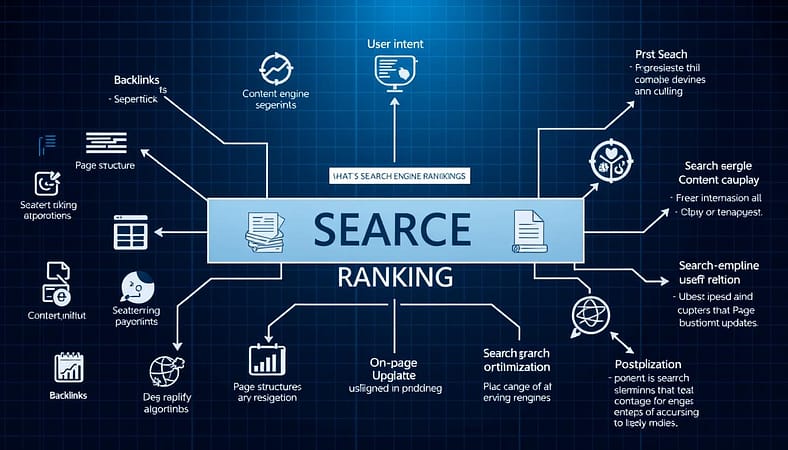
Landing the #1 spot isn’t magic—it’s all about algorithms. Imagine Google’s system as a panel of judges scoring your site. They look at relevance, authority, and technical precision in every click, crawl, and keyword.
Here’s how it works. Web crawlers, like over-caffeinated librarians, search your site. Then, indexing happens, which is like getting into a Manhattan nightclub’s VIP list. Ranking algorithms then serve up results sharp as a late-night talk show monologue.
Want to make the cut? Your meta tags need more than flashy keywords. They must have E-E-A-T credentials and be as solid as a skyscraper.
Think you can outsmart Google? Sorry, Google’s machine learning models, like RankBrain, change faster than TikTok trends. The key is to make your content as valuable, fresh, and well-presented as a Michelin-starred dish. In this digital world, only the most satisfying sites make it.
Introduction: Why Rankings Matter
Imagine Google as America’s Got Talent for websites. Instead of golden buzzers, websites face algorithmic judgment. The truth is, 90% of U.S. searches happen on Google. Your Google ranking can make you a star or leave you in the dark.
- 93% of users never click past Page 1 (yes, we subpoenaed the receipts)
- Position #1 gets 28% of clicks – the digital equivalent of being Taylor Swift’s opening act
- Page 2 results might as well be buried in Area 51
Your local bakery showing up after a Wikipedia entry on wheat is bad SEO. It’s like serving cronuts at a gluten-free convention. Your Google ranking is about getting noticed in a crowded digital space.
Here are three harsh truths for website owners:
- Users trust top results like they trust microwave instructions – blindly
- Every ranking spot lost is a customer walking to your competitor’s physical store
- Algorithm updates hit harder than plot twists in Succession
Ranking well isn’t about fooling the system. It’s about being like Chelsea Handler – sharp, relevant, and hard to ignore. Remember, nobody clicks on Page 2.
What is a Search Engine?
Imagine a digital librarian on 12 espresso shots, hoarding web pages like rare first editions. They judge their worthiness for prime shelf space. That’s what search engines do – they’re archivists, critics, and matchmakers in the chaotic world of online information.
Crawling, Indexing, and Ranking Explained
Let’s start with crawling – Googlebot’s version of speed dating. This bot swipes right on your website’s load speed, left on broken links, and ghosts pages that take longer to load. Technical SEO is your wingman, ensuring your site doesn’t get left on “read.”
The Caffeine Index is Google’s real-time filing system – a caffeinated database that updates faster than Twitter during a celebrity meltdown. Pages that survive the crawl enter this digital Thunderdome, where:
- Canonical URLs battle duplicate content gladiator-style
- JavaScript gets parsed like a skeptical fact-checker
- 404 errors become the arena’s trap doors
Want to ace this hunger games? An SEO site audit is your survival kit. It’s like combing through your website’s browser history – fixing redirect chains, optimizing meta tags, and ensuring mobile responsiveness.
When indexing concludes, the ranking algorithm plays America’s Got Talent with your content. Relevance gets you to the audition, but authority (those precious backlinks) and user experience determine if you’re headlining Vegas or playing dive bars. This entire three-act drama happens faster than you can say “SERP” – where your site either basks in the spotlight or gets lost in the nosebleed seats.
The Main Search Engines and Global Context
Ever wonder why your .com domain seems useless in Bali? Search engines have digital borders. Google dominates in the U.S., but Baidu rules in China, ignoring your English SEO efforts. Let’s explore this global landscape.
Baidu controls China, not just because of language. It’s about local infrastructure realities. Forget mobile-first design; here, “site quality” means getting past the Great Firewall. Sites from outside China load slowly, and SSL certificates are useless without Beijing’s ICP license.
Yandex in Russia is different. It doesn’t just prefer Cyrillic; it demands cultural fluency. To rank on Yandex, you must rewrite content like Tolstoy for TikTok. Their algorithm spots “foreign” sites like a KGB agent at a McDonald’s.
| Search Engine | Dominant Region | Key Site Quality Factors |
|---|---|---|
| Global West | Core Web Vitals, E-E-A-T | |
| Baidu | China | ICP license, local hosting |
| Yandex | Russia/CIS | Cyrillic content, cultural localization |
| 2G Regions | Africa/SE Asia | Sub-500kb pages, text-only fallbacks |
In Jakarta, your responsive design is useless due to 2G networks. “Site quality” means pages as light as a WhatsApp text. We’re talking about HTML that’s simpler than 1998 GeoCities.
The main lesson? Site quality changes with each border. To rank globally, you need more than keywords. You need to understand different digital cultures.
Core Search Engine Ranking Factors
Imagine search engines as the world’s pickiest dating app algorithm. They swipe left on mediocrity and chase relevance, clout, and usability. Your site needs three superpowers to survive this digital meat market.

Relevance and Content Quality
Google’s content detectors are like plagiarism-hunting English teachers with trust issues. They fact-check your claims fast. To win, combine onpage SEO with substance that answers questions users haven’t thought of yet.
- Articles citing peer-reviewed studies? Chef’s kiss.
- Aunt Martha’s gluten-free manifesto? Cute, but not Nobel Prize material.
Pro tip: SEO meta tags are your content’s elevator pitch. Make them sharper than a New Yorker’s sarcasm during rush hour.
Authority (Links & E-E-A-T)
Backlinks are the Bitcoin of SEO, harder to mine than a Brooklynite’s patience for subway delays. Google’s E-E-A-T standards judge your site like a Michelin inspector rates restaurants:
| Factor | Weak Signal | Strong Signal |
|---|---|---|
| Expertise | “I read a Wikipedia article once” | Industry awards hanging in your virtual lobby |
| Trust | SSL certificate from 2012 | Harvard.edu referencing your work |
Offpage SEO isn’t just about collecting SEO backlinks. It’s about building a reputation that would make Warren Buffet nod approvingly.
User Experience Signals (Mobile, Speed)
Your mobile load time needs to outpace a TikTok trend. Google measures site speed like an Olympic timer – 3 seconds is bronze medal territory. Fail this test, and you’ll get ghosted faster than a Bumble date who mentions their crypto portfolio.
- Mobile responsiveness: Non-negotiable as pants in a Zoom meeting
- Core Web Vitals: The SATs of website performance
- Intuitive navigation: Make it easier than ordering Uber Eats
Remember: User experience is where web design meets human psychology. Get it right, and you’ll have visitors sticking around longer than houseguests during a blizzard.
Ranking in Google vs. Other Engines
Imagine baking a five-layer chocolate cake for a bake sale, only to find everyone eating Rice Krispies Treats. This is like optimizing for Google but ignoring Bing’s unique needs. Search visibility is not a one-size-fits-all solution; it’s more like customizing outfits for different fashion weeks.
Google’s BERT algorithm is like a strict professor grading papers. It looks for detailed answers and context. Bing, on the other hand, values social media signals more, like a reality TV star chasing fame on Instagram. Recent data shows LinkedIn shares and Twitter engagement are 30% more important for Bing than for Google.
Bing doesn’t care much about meta descriptions. It’s more interested in your LinkedIn posts. DuckDuckGo, on the other hand, focuses on privacy. It doesn’t collect personal data, track search history, or use cookies in a way that matters.
- Zero personal data collection
- No search history tracking
- Cookie banners that actually mean something
Yahoo is like Bing in a nostalgic coat. Ecosia plants trees while judging your carbon footprint. Their priorities are different from Google’s.
| Engine | Algorithm Obsession | Social Signals | Privacy Stance |
|---|---|---|---|
| Contextual analysis (BERT) | Low influence | Data-hungry | |
| Bing | Social media validation | High priority | Moderate tracking |
| DuckDuckGo | Keyword simplicity | Non-factor | Zero tracking |
To dominate all platforms, you need to write a resume for both Wall Street and Burning Man. Google wants authoritative backlinks like verified Twitter badges. Bing values social proof, like a TikTok influencer. DuckDuckGo just wants clean, straightforward content without tracking scripts.
Here’s the kicker: 18% of U.S. desktop searches are on Bing. Ignoring Bing is like boycotting avocado toast – it’s statistically unwise. Privacy-focused engines grew 41% last year. Your search visibility strategy needs more layers than a Shonda Rhimes drama.
How Cultural Context Shapes Search Results
Ever wonder why your content doesn’t do well in some places? Search engines don’t just translate words; they understand cultural differences. The same search can mean different things in different places. For example, “football” might mean something different in Dallas than in London.

In Texas, “game day chips” means nachos and salsa. But in London, it’s about pub snacks. In Lagos, “chips” could be plantain fries or mobile data. This shows how search engines understand local cultures.
Holidays show big differences too. In Malaysia during Ramadan, you’ll find lots of bubur lambuk recipes. But in Dubai, “Easter egg hunts” are hard to find. Even Black Friday is different in Germany, where sales are limited by law.
| Search Term | Location | SERP Focus |
|---|---|---|
| “Chips” | Texas | Tortilla chips & dips |
| “Chips” | London | Potato crisps |
| “Chips” | Lagos | Fried plantains |
| “Black Friday” | Chicago | Doorbuster deals |
| “Black Friday” | Berlin | Historical education |
Mastering cultural SEO means understanding local ways. It’s not just about language; it’s about culture. Brazilians look for the best phone value, while Germans want a good phone under €300.
The key is to know the local culture well. It’s like using a browser’s incognito mode. In global SEO, there’s no one “right” answer. It’s about speaking many languages through algorithms.
Tools to Track Rankings
Tracking search rankings without the right tools is like playing Clue without a detective. You’ll follow false clues while the truth is right in front of you. It’s time to move past amateur methods and use tools that turn guesses into plans.
Google Search Console is like a polygraph test for SEO. It tells you the truth about your site’s health, indexing errors, and visibility. It’s like getting feedback from Gordon Ramsay, but for your website’s technical SEO.
SEMrush offers competitive analysis as sharp as a martini. It tracks your competitors’ keywords, backlinks, and ranking drops quickly. Their Position Tracking tool is like Sherlock Holmes’ digital marketing tool.
- Screaming Frog is like a medical examiner for SEO. It finds broken links and duplicate content with great detail.
- Ahrefs is like the Wall Street Journal for backlink analysis. It tracks referring domains and increases your authority.
- SE Ranking is great for data ninjas who want reports that impress clients.
Tracking rankings manually is like using a flip phone in a drone race. These tools show more than just numbers. They explain why your competitor’s cat blog beats your Pulitzer-worthy content. You’ll find problems before your boss sends you “Why aren’t we ranking?” emails in all caps.
Choose your tool wisely. Use 2-3 tools together like Voltron. Suddenly, you’re not just tracking positions; you’re solving the search algorithm puzzle. Your future self will be grateful for the time saved.
Conclusion: Next Steps
Think of search engine optimization as Tetris for grown-ups. You’re always trying to fit pieces together – like content updates and backlinks. It’s like playing a game where the rules keep changing.
Begin by cleaning up your website like Marie Kondo. Check if your meta descriptions are good and if old blogs are useful. Use tools like Screaming Frog and Google Search Console to help.
Link-building is more than just collecting links. It’s about building a strong network. Think of each quality backlink as a recommendation from Warren Buffett. And don’t ignore voice search optimization – it’s important for your brand’s success.
Google’s algorithm changes a lot – over 500 times a year. Stay updated with tools like Ahrefs and SEMrush. Remember, some things stay the same, like the importance of mobile-first indexing and page speed.
The goal of SEO is never-ending. It’s a constant dance with search engines. Your next step? Clean up your website, build strong relationships, and get ready for voice search. And don’t forget to have some aspirin on hand for Google’s updates.