
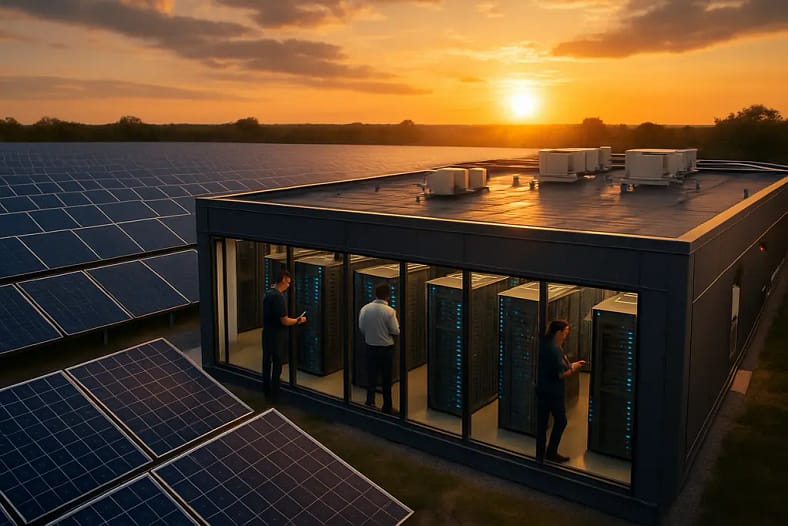
AI Energy Requirements are now a material planning issue for data center operators, grid planners, policymakers, and publishers covering technology infrastructure. The available evidence does not support simple claims that AI alone determines the environmental outcome of digital growth. It does show that AI workloads are adding pressure to an already expanding data center sector, with electricity demand, cooling needs, site selection, and reporting quality becoming more important to public analysis.
For link-building teams, the opportunity is not to repeat broad claims about AI being either harmless or catastrophic. Stronger assets separate measured electricity use from projections, distinguish AI-focused facilities from the wider data center estate, and explain the uncertainty around local impacts. That approach makes outreach more credible because it gives journalists, researchers, and technical readers verifiable context rather than inflated talking points.
How AI Energy Requirements Change Load Planning
AI Energy Requirements In The Available Data
The International Energy Agency reported that data centers used about 415 terawatt-hours of electricity in 2024, equal to roughly 1.5% of global electricity consumption, according to its Energy and AI executive summary. That figure covers data centers as a category, not only AI training or inference. This distinction matters because cloud computing, enterprise hosting, storage, networking, and traditional web services also contribute to the same load.
The same IEA analysis states that global data center electricity consumption could more than double by 2030. A projection of that size should be treated as scenario-based rather than guaranteed. Electricity demand depends on hardware efficiency, server utilization, cooling design, regional grid constraints, software deployment patterns, and how quickly demand for compute-intensive services grows. The technical reading is narrower than many headlines suggest: the data center sector is large enough to affect energy planning, and AI is one factor increasing the pressure.
Why Share Of Electricity Demand Can Mislead
Percentages can hide operational strain. A global share near 1.5% may look modest, but data centers are not evenly distributed across grids. Facilities cluster where land, fiber connectivity, tax structures, power availability, and cooling conditions make projects viable. That concentration can create local pressure even when the worldwide percentage remains comparatively small. A national or regional utility may face demand growth from a small number of campuses long before the global power system appears constrained.
This is where AI Energy Requirements become a site-specific issue. AI-focused workloads can require dense racks, high-performance accelerators, and cooling systems designed for higher thermal output than many legacy server halls. The evidence available here does not quantify rack density or cooling technology by facility, so any site-level claim should be avoided unless supported by operator disclosures, utility filings, or local permitting records. For public content, the safer claim is that AI workloads can increase planning sensitivity around peak load, interconnection timelines, and cooling capacity.
United States Exposure Through 2030
Forecast Ranges Are More Useful Than Single Numbers
The United States illustrates why uncertainty should be visible in data center coverage. Lawrence Berkeley National Laboratory’s 2025 update forecasts that data centers could account for 11.8% of U.S. electricity use by 2030, with a plausible range from 9.5% to 15.3%, depending on scenario assumptions, in the United States Data Center Energy Usage Report. The range is as important as the central value because it shows that the outcome depends on adoption, efficiency, and infrastructure decisions rather than a fixed path.
That forecast has direct implications for utilities, state regulators, corporate energy buyers, and communities near proposed campuses. If data center demand takes the lower path, grid upgrades and procurement strategies may still be substantial in some markets. If it moves toward the upper end of the range, power availability, generation mix, and transmission planning become more visible constraints. The report does not remove uncertainty; it frames it in a way that lets planners compare scenarios.
Environmental Impacts Depend On Grid And Cooling Context
Electricity use is the easiest metric to compare, but environmental impact depends on how that electricity is generated and delivered. A megawatt-hour from a lower-carbon grid has a different emissions profile than a megawatt-hour from a fossil-heavy grid. Water use is also configuration-dependent. Evaporative cooling, air cooling, liquid cooling, climate, and operating temperature targets can change water demand, but the research provided here does not include source-approved facility-level values. Any article or outreach asset should state those limits rather than implying that every data center has the same water profile.
The same caution applies to claims about AI Energy Requirements and carbon emissions. Electricity demand can be measured or forecast, but emissions require assumptions about grid mix, time of consumption, power purchase agreements, backup generation, and accounting boundaries. A cautious analysis should avoid treating energy consumption and emissions as interchangeable. They are related, but they are not the same metric.
What The System Does And Does Not Show
Measured Demand Is Not The Same As AI Attribution
A core measurement problem is attribution. Data center operators may not disclose how much electricity supports AI training, inference, storage, conventional cloud workloads, or mixed enterprise applications. Even when a facility is marketed as AI-focused, workloads can change across time. Public estimates often depend on model assumptions, hardware shipment data, capacity additions, and utilization rates. Those inputs can be reasonable, but they are not the same as direct metering of every workload category.
For technical readers, this limits how aggressively a publisher should interpret the data. It is fair to say data center electricity demand is rising and that AI workloads contribute to that rise. It is less defensible to assign all new data center energy use to AI without facility-level evidence. That distinction improves both editorial accuracy and link quality because it gives other sites a reason to cite the work as a careful explainer rather than a promotional claim.
Efficiency Gains May Offset Some Growth, But Not All Risk
Hardware and cooling efficiency can reduce electricity use per unit of compute, but efficiency does not automatically reduce total demand. If compute use grows faster than efficiency improves, total electricity consumption can still rise. The research supplied here supports a demand-growth framing through 2030, not a precise claim about which efficiency pathway will dominate. That is an important boundary for evidence-based content.
Maintenance also matters. High-density facilities depend on reliable cooling, power distribution, battery systems, backup generation, network uptime, and operational monitoring. Environmental performance is not only set during design. It changes with utilization, component replacement, cooling configuration, and power procurement. These factors are difficult to compress into a single headline number, which is why data assets should show assumptions and date stamps.
Link-Building Value From Evidence-Led Energy Coverage

Data Assets Need Clear Definitions
For link acquisition, AI Energy Requirements can be turned into credible assets when the methodology is visible. A useful page should define whether it covers all data centers or only AI-focused facilities, whether figures are measured or projected, and whether the geography is global, national, or local. The strongest outreach targets are likely to be energy reporters, infrastructure analysts, policy researchers, sustainability teams, and technology publications that need reliable context.
Clear definitions also reduce correction risk. If a chart labels a 2030 value as a forecast, the reader understands that it depends on assumptions. If a paragraph identifies a figure as global rather than U.S.-specific, it avoids mixing incompatible scales. For teams mapping adjacent topics such as networks, compute infrastructure, and energy reporting, technology infrastructure analysis can support internal topical alignment without forcing an unrelated anchor into the article.
- Separate measured electricity consumption from scenario-based forecasts.
- Label the geography of every figure before comparing data points.
- Distinguish data center demand from AI-specific workload attribution.
- Explain uncertainty in grid emissions, water use, and cooling design.
Outreach Should Avoid Inflated Environmental Claims
Journalists and analysts are more likely to reference work that can survive technical review. A cautious pitch might focus on what the IEA and LBNL data imply for electricity planning, rather than claiming a fixed emissions outcome. It can also compare global and U.S. exposure, explain why local grid effects may differ from global percentages, and show where public reporting remains incomplete.
This type of content also supports internal link strategy. Pages about AI infrastructure, semiconductor demand, data center cooling, grid planning, and sustainability reporting can reference one another when the relationship is factual. The goal is a connected evidence base, not a group of pages repeating the same keyword. Search visibility and earned links both depend on whether the page helps a reader understand the issue with less ambiguity.
AI Energy Requirements For Link Builders
AI Energy Requirements are best treated as a measurable infrastructure topic with unresolved variables, not as a slogan. The reliable points are clear: data centers already account for a measurable share of global electricity use, international agencies expect substantial demand growth by 2030, and U.S. forecasts show a wide but significant range of possible national electricity exposure. The uncertain points are also clear: exact AI attribution, facility-level water use, emissions outcomes, and local grid effects depend on assumptions and site-specific data.
For link builders, that combination is useful. It creates room for charts, explainers, regional comparisons, and source-based outreach while rewarding caution. The most defensible content will show dates, units, definitions, and source boundaries. That may sound less dramatic than broad claims about AI’s environmental cost, but it is more likely to earn citations from readers who check the numbers before linking.