

Google’s 2026 guidance on generative AI features gives website owners a clear message: AI search does not require a separate technical playbook. Pages still need to be crawlable, indexable, useful, and easy to interpret. Google says its generative AI features use core Search systems to retrieve relevant web pages, then draw on those pages when building responses. That makes ordinary SEO discipline more valuable, not less.
For publishers, developers, and content teams, the practical task is to reduce ambiguity. Search systems need access to the page, users need a satisfying experience, and the content needs enough original value to deserve retrieval. New AI-facing terminology can sound attractive, yet Google’s own documentation places foundational SEO, content quality, page experience, and policy compliance at the center of visibility in AI Overviews and AI Mode.
Google’s 2026 AI Search Guidance Rejects The Shortcut Mindset
On May 15, 2026, Google published a new resource for site owners focused on generative AI features in Search. The guidance states that standard SEO practices remain relevant. It describes retrieval-augmented generation and query fan-out as parts of the process used to retrieve material from Google’s Search index for AI-generated responses.
That matters for teams tempted to build a second layer of “AI-only SEO.” Google says there is no need to rewrite pages into tiny chunks for generative AI systems, no special schema.org markup is required for AI features, and an llms.txt file does not improve or damage visibility in Google Search. The Google AI search guidance instead points publishers back to clear site structure, crawlable content, original information, useful media, and a satisfying page experience.
The practical shift is less dramatic than the marketing language around AI search suggests. A page still needs a clear subject, a useful answer, meaningful supporting detail, and enough technical accessibility for Search to process it. Content teams gain more from improving those fundamentals than from inventing markup or publishing near-duplicate pages for every imagined fan-out query.
Crawlability And Page Experience Still Decide Eligibility
Google says a page must be indexed and eligible to appear in Search with a snippet before it can appear as a supporting link in AI Overviews or AI Mode. There are no separate technical eligibility requirements for those features. That puts familiar checks back at the front of the workflow: robots directives, HTTP status codes, internal discovery, canonicalization, rendered content, mobile usability, and JavaScript accessibility.

Site owners should treat page experience as part of retrieval readiness rather than a cosmetic layer. Google’s Core Web Vitals guidance continues to use LCP, INP, and CLS as field metrics for loading, responsiveness, and visual stability. The published “good” thresholds are an LCP within 2.5 seconds, INP below 200 milliseconds, and CLS below 0.1.
Those numbers are not a guarantee of rankings. They are practical UX targets that help teams find friction affecting real visitors. A fast page with thin content will not become valuable through performance work alone, just as a strong article can lose users if intrusive elements, slow interaction, or unstable layout makes the page frustrating to use.
Content Quality Has To Survive Query Fan-Out
Google’s AI search documentation describes query fan-out as a method that generates related searches so the system can gather supporting material across connected aspects of a question. For publishers, that raises the value of pages that answer a topic with enough depth to remain useful across several related retrieval paths.
The safest response is not to create dozens of small pages targeting every possible variation. Google explicitly warns against scaled content created mainly to manipulate rankings or generative AI responses. Its people-first content guidance asks whether a page contains original information, research, analysis, or substantial value beyond what is already available elsewhere.
Google introduced dedicated generative AI performance reporting in Search Console on June 3, 2026, with an initial rollout to a subset of websites. That reporting gives site owners a better way to observe impressions from generative AI features without inventing proxy metrics. The useful measurement question becomes straightforward: which pages earn visibility, which queries lead users to the site, and what content or technical traits do the stronger pages share?
Outbound Links Need Context, Not Keyword Theater
Links still serve readers when they point to material that extends the subject of a page. The surrounding sentence should make the destination predictable, and the anchor should explain what a visitor will find after the click. In a high-competition affiliate niche, for example, a comparison article may reference a specialist resource using descriptive wording such as most trusted offshore sportsbooks. That phrase works as an anchor only when the surrounding topic genuinely concerns sportsbook evaluation; inserting the same link into unrelated copy would weaken editorial coherence.
Google’s current spam policies draw a separate line around links created primarily to manipulate rankings. Paid links, advertorial placements, or commercial arrangements that pass ranking credit can fall under link spam. Google recommends qualifying paid or sponsored links with rel="sponsored" or rel="nofollow" where appropriate.
This distinction matters for publishers running guest content, affiliate projects, or sponsored editorial programs. The technical SEO goal is not to force exact-match anchors into pages. It is to maintain a defensible relationship between the page topic, the destination, the anchor wording, and the reason the reader benefits from the reference.
Structured Data Should Describe The Page, Not Chase AI Features
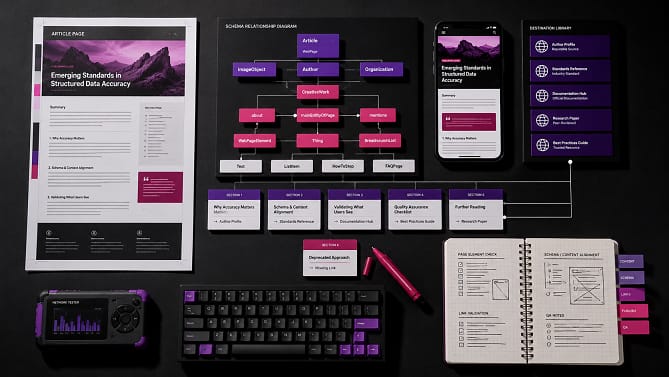
Structured data remains useful, but its job is narrower than many AI-search pitches imply. Google says there is no special structured data required to appear in AI Overviews or AI Mode. Existing structured data can still help Search interpret page entities and make pages eligible for supported rich-result formats.
For articles, Google’s Article structured data documentation supports Article, NewsArticle, and BlogPosting. Recommended properties include elements such as the headline, image, publication and modification dates, and author information. Google recommends JSON-LD as a supported implementation format in its general structured data guidance.
The larger rule is consistency. Markup should describe content that users can actually see on the page. A site gains little from adding schema properties that exaggerate, mislabel, or hide the real content. Validation can catch syntax and eligibility problems, but valid markup does not guarantee a rich result. Structured data is a machine-readable description layer, not a ranking shortcut.
The Best 2026 SEO Strategy Is A Better Quality-Control System
AI search has changed how results can be assembled and presented, yet the publishing workflow still rests on familiar engineering and editorial checks. A strong page should return the correct status code, permit crawling, expose its main content in a form Search can process, use logical links, load cleanly on mobile devices, and carry structured data that matches the visible page.
The content layer needs the same discipline. Each article should have a clear reason to exist, original value that is difficult to replace with a generic summary, precise sourcing, and enough context for a reader to make use of the answer. Search Console can then show whether those pages earn impressions in classic results and generative AI features as reporting becomes available.
The main opportunity for website owners in 2026 is operational. Treat AI-search visibility as the output of content quality, technical accessibility, user experience, and policy-safe publishing. That approach is slower than chasing a new acronym, but it produces a site that remains understandable to search systems and useful to people when search interfaces change again.