
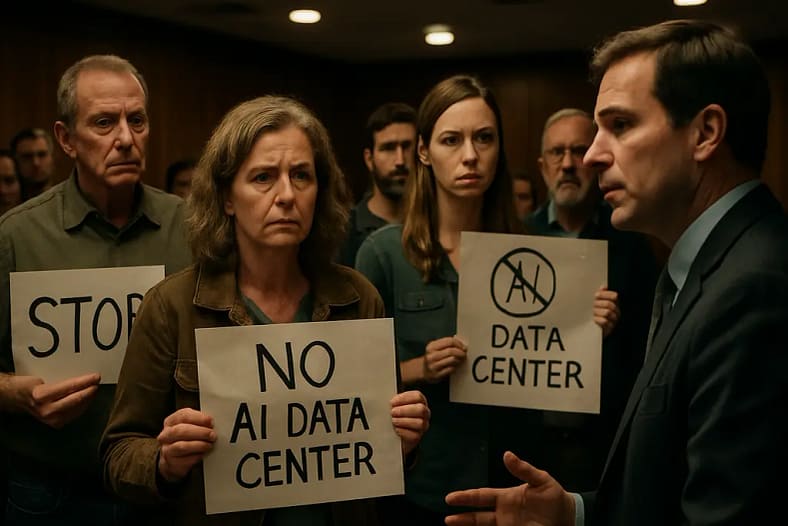
AI data centers have moved from a mostly technical siting question to a local governance dispute involving electricity supply, water demand, air permitting, noise, tax policy, and public process. The evidence available on October 10, 2026, does not support a single national story in which every community responds the same way. It does show a measurable rise in resistance, with several state and local cases showing why permitting risk has become harder to separate from engineering risk.
The central issue is not whether computing demand exists. The issue is whether communities believe the costs and benefits of new facilities are being measured and shared clearly. For developers, utilities, regulators, and residents, the recent record suggests that technical claims about efficiency or economic development are not enough when project documents leave uncertainty around grid strain, water withdrawals, backup power, emissions, local tax treatment, or public notice.
Why AI data centers Face Local Resistance
Survey Evidence For AI data centers
The most direct national evidence comes from public polling. An Annenberg Public Policy Center survey conducted from June 16 to July 19, 2026, found that 61% of U.S. adults somewhat or strongly opposed building new data centers in their local area, up from 49% in March 2026 according to Annenberg. A separate Gallup poll released in May 2026 found that 70% of Americans opposed data centers being built near their communities, including nearly half who strongly opposed them as reported by The Washington Post.
Those surveys should not be treated as identical measures. They were fielded at different times and used different wording. Still, both point in the same direction: local siting has become a public concern, not only an infrastructure-planning issue. The shift matters because data center construction schedules depend on zoning decisions, utility interconnection, environmental permits, tax agreements, and sometimes annexation or special-use approvals.
Concerns Are Practical, Not Abstract
Residents and local officials have raised concerns that can be tested through documents, permits, and utility filings. The recurring categories are power demand, water use, noise, lighting, emissions, emergency backup systems, property tax treatment, and the degree of public participation before permits are issued. These are not secondary communications issues; they affect project design, operating limits, community benefit claims, and litigation exposure.
The research record also indicates that more than 30 state legislatures or regulatory bodies introduced or adopted laws between April and June 2026 targeting data center siting, grid impact, and water usage. During that same period, projects valued at about $68 billion were reported as blocked or delayed due to local opposition and regulatory pressure. That figure should be read as a project-value estimate, not as a verified cost to the economy or a measure of permanent cancellation.
Case Signals From States And Communities
New York’s Moratorium And Permit Risk
On July 14, 2026, New York State issued a moratorium, signed by Governor Kathy Hochul, that halted environmental permits for large data centers for up to one year while rules were developed around grid strain, environmental impact, and community effects. The significance is procedural as much as technical: the state chose to pause permitting rather than approve projects under rules it viewed as incomplete for the scale of proposed facilities.
That type of pause changes developer risk models. A project can have land control, financing assumptions, and demand forecasts, yet still face delay if the permitting authority concludes that existing rules do not cover grid or environmental effects with enough precision. Related analysis of AI data center permitting barriers shows why energy, environmental review, and local approval are now linked in many project timelines.
Texas, Oregon, New Jersey, And Memphis
Local cases show how opposition varies by place. In Taylor, Texas, northeast of Austin, the city council debated annexing a planned 664-acre data center campus. Under the proposed annexation, developers agreed to stricter noise, lighting, setback, and water rules under city jurisdiction. That case suggests local governments may not always reject a project outright; they may instead seek tighter operating conditions and clearer authority over impacts.
In Oregon, expanding data center operations produced backlash involving residents, environmental groups, educators, and farmers. Projects in Hillsboro alone received more than $85 million in property tax exemptions, while Oregon facilities received more than $450 million in exemptions in 2026. Those numbers explain why tax policy has become part of the opposition, especially where residents question whether public incentives match local infrastructure burdens.
In Vineland, New Jersey, residents opposed a planned 350-megawatt AI facility because of concerns about noise, emissions, and effects on local water supply. The site was described as near wetlands and a protected aquifer, and the facility was projected to use up to 20 million gallons of water per year. In Memphis, an April 2026 lawsuit filed by the Southern Environmental Law Center on behalf of the NAACP against Elon Musk’s xAI project alleged that 27 unpermitted gas turbines could emit more than 1,700 tons of nitrogen oxides, 19 tons of formaldehyde, and 180 tons of fine particulate matter annually in an area already graded F for ozone.
Technical And Governance Issues Driving Opposition

Grid, Water, Noise, And Air Permits
AI data centers are often evaluated through square footage and job counts, but public objections tend to focus on operating inputs and external effects. A large compute facility needs reliable electricity, cooling capacity, transmission access, backup systems, and physical security. Each element can create a separate local concern: grid strain may affect utility planning, water withdrawals may affect agricultural or residential users, backup generation may trigger air-permit scrutiny, and noise from cooling or power equipment may affect nearby homes.
The technical question for public agencies is whether project documents quantify those effects in a way that can be checked after approval. Conditions on noise, lighting, setbacks, water use, or emissions are more useful when they define measurement methods, reporting intervals, enforcement authority, and consequences for noncompliance. Without those details, community assurances can become difficult to verify.
Transparency And Segmented Power Plans
Transparency concerns intensified in 2026. A report published on October 8, 2026, by Earthjustice warned that Bring Your Own Power projects, often involving gas-fired power infrastructure, were using permit segmentation and weak regulatory oversight while receiving public subsidies, tax breaks, and expedited treatment. The core governance concern is that a data center and its power supply may be reviewed in pieces, reducing the ability of the public to assess total environmental and grid effects.
A separate September 2026 EPA proposal would remove federal mandates that states notify the public or accept comments before issuing air-pollution permits for data centers and industrial facilities. Critics said that change would reduce community input in permitting decisions. Regardless of the final policy outcome, the proposal showed why process is now part of the substantive dispute: residents are not only asking what will be built, but also who gets to review it before approval.
For agencies and civic groups, clear visual summaries can help residents compare permitting claims, water estimates, and local benefit proposals. A related site in the same network, freeslideshows.com, is relevant for turning technical meeting material into simpler public presentations without replacing the underlying permit documents.
Public Opposition To AI data centers In The U.S.
What Developers And Public Agencies Can Verify
The current evidence shows AI data centers face public opposition when residents see uncertainty around local burdens, public incentives, and accountability. Developers can reduce ambiguity by publishing power-demand assumptions, water-use estimates, backup-generation plans, noise modeling, tax-abatement terms, and monitoring commitments in formats that non-specialists can review. Public agencies can reduce conflict by applying the same disclosure expectations across applicants and by making comment periods, hearing records, and permit conditions easy to find.
This does not mean every objection will be resolved through better disclosure. Some communities may decide that the local costs remain too high, even with stricter conditions. Others may accept projects that include enforceable limits and measurable local benefits. The evidence supports a narrower claim: public opposition has become material to siting, permitting, and project timing, and it is strongest where technical impacts and public review are not addressed with enough precision.
For case-study analysis, the lesson is cautious but clear. Treat community acceptance as part of infrastructure feasibility, not as a public-relations task added after engineering decisions are made. Power, water, emissions, tax policy, and transparency are now the variables most likely to determine whether a proposed facility moves from plan to permit.