
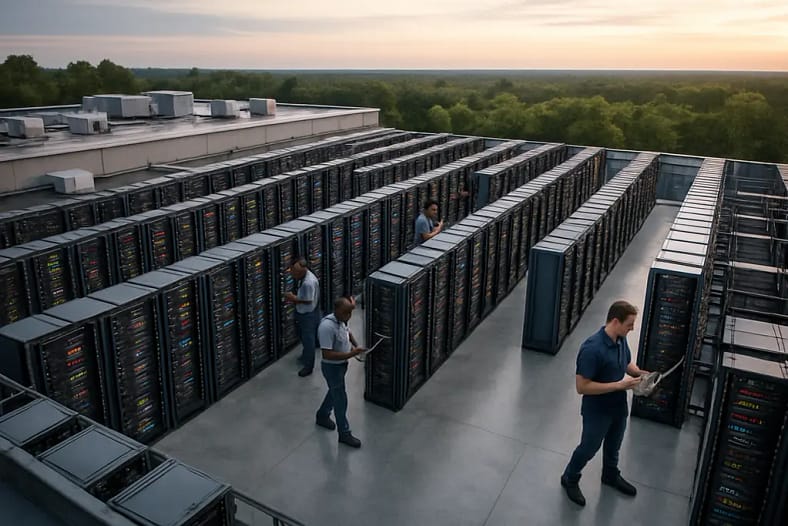
Data Center Energy is no longer a background infrastructure issue for SEO teams that depend on crawling platforms, log analysis, rendering tests, AI-assisted workflows, and large-scale monitoring. The available U.S. figures show a fast-rising electricity demand category, but they also carry uncertainty that should shape how technical teams interpret vendor claims, publish analysis, and plan tool usage.
The strongest data point in the supplied research is the national electricity estimate for U.S. data centers. In 2024, they used about 192 terawatt-hours of electricity, equal to 4.7% of total U.S. electricity consumption, according to the DOE 2025 update. The same research notes a 14% increase from 2023 to 2024, driven largely by GPU- and ASIC-accelerated servers and higher power ratings per device. For SEO operations, that does not mean every crawl or report is a material grid event. It does mean the infrastructure behind common tools is part of a larger demand pattern that is now measurable at national scale.
Data Center Energy Baseline For U.S. Demand
What Data Center Energy Measures
Data Center Energy figures in the cited reports describe electricity consumed by U.S. data centers as a category. They do not isolate the electricity attributable to SEO software, search bots, AI content systems, analytics processing, or one cloud provider. That distinction matters. A national figure can inform strategy, but it should not be converted into a per-keyword, per-crawl, or per-report estimate without direct metering data from the platforms involved.
The baseline is still useful because it gives scale. A 192 TWh annual demand figure places data centers among major electricity-consuming systems. The 4.7% share of U.S. electricity consumption also frames why utilities, operators, policymakers, and large enterprise customers have begun treating compute growth as a planning variable rather than a narrow IT cost. For publishers and SEO tool buyers, the practical implication is not to abandon compute-intensive analysis. It is to ask better questions about necessity, scheduling, duplication, retention, and measurement quality.
Why The 2024 Estimate Matters To SEO Teams
SEO work often rewards frequent measurement: recurring crawls, rank tracking, JavaScript rendering, internal-link audits, content inventories, and log file processing. Those activities depend on data center infrastructure, either through SaaS vendors or internal cloud deployments. The national energy figures do not prove that SEO workloads are a large share of demand. They do justify more precise governance around automated tasks that may run by habit rather than need.
A cautious operating model starts by separating high-value checks from noise. Crawling a large site daily may be reasonable during a migration, incident response, or template release. The same cadence may be excessive for stable sections with low change rates. Evidence-based teams can document why a crawl frequency exists, what decision it supports, and when it should be reduced.
Forecast Range And Planning Uncertainty
2030 Projections Are Wide, Not Fixed
The 2030 projection is the main planning signal, but it should be read as a range rather than a fixed destination. The cited Lawrence Berkeley Lab publication estimates that U.S. data center electricity usage could reach 649 TWh by 2030, equal to about 11.8% of total U.S. electricity use. It also provides a sensitivity range of 521 to 843 TWh, or 9.5% to 15.3% of total U.S. electricity use, in the Lawrence Berkeley Lab report.
That range is central to any technical strategy discussion. A single headline number can make demand growth appear more certain than the evidence supports. The sensitivity band shows that assumptions about workload growth, hardware deployment, utilization, cooling, efficiency, and siting can change the result materially. The correct SEO takeaway is not a prediction that every tool will become more expensive or constrained. The defensible takeaway is that compute-dependent workflows should be managed with cost, energy, and operational exposure in mind.
Near-Term Growth Signals Need Date Discipline
The research notes that the Reference Case forecast expected U.S. data center electricity need to grow by 22% in 2025 and 29% in 2026, with a near-term compound annual growth rate around 21%. As of October 15, 2026, those 2025 and 2026 figures should be treated as report projections unless replaced by measured annual data. That distinction is not editorial caution for its own sake; it prevents strategy documents from mixing measured history with modeled expectation.
SEO teams can apply the same discipline to vendor documentation. If a platform says it has reduced processing time, improved rendering efficiency, or optimized AI features, the useful follow-up is methodological: compared with which version, workload, hardware configuration, time period, and output quality threshold? Without those details, efficiency language may be directionally useful but not decision-grade.
Operational Implications For SEO Tool Governance
Tool Settings Can Reduce Waste Without Weakening Analysis
Many energy-aware changes in SEO tooling are also quality-control changes. Teams can reduce repeated work, narrow crawl scope, retain only decision-useful exports, and coordinate audits so multiple vendors are not collecting the same evidence at similar intervals. Those steps do not require speculative claims about the exact electricity use of a single report. They follow from the broader fact that compute demand has a measurable and growing electricity footprint.
- Set crawl frequency by page-change rate, release schedule, and risk level rather than a default calendar habit.
- Use sampling for exploratory audits, then expand only when the sample identifies a material issue.
- Document which recurring reports have owners, decisions, and retirement dates.
- Separate essential monitoring from dashboards that are rarely reviewed or acted on.
This is where SEO, engineering, and procurement overlap. A technical SEO team may not control the data center, but it can control the workload it requests. For a related treatment of infrastructure exposure in search work, see this technical SEO energy analysis. For adjacent infrastructure reading within the same network, the Camp Techwise infrastructure coverage offers valuable insights for teams comparing compute, devices, and operational constraints.
Procurement Questions Should Be Specific
Vendor evaluation should avoid vague sustainability language. Better questions focus on measurable practices: whether customers can control crawl depth and frequency, whether rendering can be limited to templates that need it, whether historical exports have retention controls, and whether API usage can be monitored by project. These are not only environmental questions. They affect bill predictability, queue times, data duplication, and incident response.
SEO teams should also avoid overstating what they can know. Without platform-level metering, they cannot calculate the exact grid impact of a keyword database update or a site audit. They can still build a governance record that shows workloads are intentional, proportionate, and periodically reviewed. That record is valuable if finance, legal, compliance, or sustainability teams ask why a tool is running large recurring jobs.
Data Center Energy Implications For SEO Tools
Evidence-Based Strategy Beats Generic Claims
Data Center Energy projections change the frame for SEO tools, but they do not support panic or blanket restrictions. The measured 2024 demand figure and the 2030 sensitivity range point to a growing infrastructure category with real uncertainty. SEO teams should respond with better workload design: fewer redundant crawls, clearer report ownership, stronger vendor questions, and careful separation between measured data and modeled forecasts.
The most defensible strategy is practical. Keep the analyses that reduce technical risk, improve user access, or support revenue-critical decisions. Reduce automated work that no one reviews, no decision depends on, or another system already performs. That approach respects the evidence without treating every compute task as equally consequential. It also gives SEO teams a clearer way to explain how their tools fit into wider energy planning discussions shaped by U.S. data center growth.