

Imagine your website lost in a digital forest, with only a compass labeled “hopes and prayers.” That’s beginner SEO without a plan—a path to being unseen by search engines. It’s time to switch to a strategy that shines.
We’re starting with Mozlow’s hierarchy, a guide to surviving in the digital world. Forget about being seen; we’re focusing on being found first. Without technical SEO, your site is like a party in a desert.
Why is content strategy more important than ever? Google’s algorithm now scans quickly, like a TikTok user. Your meta descriptions are like elevator pitches in a world of tall buildings. Your backlinks are like social proof in a time of doubt.
The harsh truth is, treating SEO like an optional Netflix subscription can hurt your site’s visibility. The SEO basics we’re learning are like cheat codes for success—no need for tricks.
Are you ready to make your website stand out? We’ll explore SEO best practices through the eyes of humans and machines. In 2024, ranking is about speaking Google’s language, not just trying to outsmart it.
What is SEO?
SEO is like your website’s GPS in the vast internet world. It helps search engines find your site without getting lost. It has come a long way from the early days of keyword stuffing.
The Three-Legged Stool of Digital Relevance
SEO is like your grandma’s chicken soup recipe. If you miss one ingredient, it’s a disaster. Here’s what makes it work:
- Technical Setup: Your site needs to load fast, like a well-oiled machine
- Content Quality: Your content should be valuable, not just stuffed with keywords
- Backlinks: Getting links from trusted sites boosts your credibility
Black hat SEO is like using shortcuts that don’t last. It might get you to the top fast, but Google will catch up. Remember, organic growth is the best way to go.
When all these elements work together, you’ll see great results. Google will be your biggest supporter. But, if you mess up, your site will fade away.
Why SEO Matters: Benefits and Realities
Think you can outsmart 5 billion daily Google searches? SEO is more than just ranking. It’s about surviving in a world where 75% of clicks disappear before reaching Page 2. Three-quarters of users never look beyond the first page, making SEO your key to success.

Our “vacuum cleaners” case study is a prime example. With 223,000 monthly searches, it seems like a goldmine. But without SEO, you’re left with nothing. First-page results get 95% of clicks, while page 2 is almost ignored.
Here’s the reality check:
- Websites without SEO grow slower than a DMV line
- Content freshness matters more than your morning coffee ritual
- Google’s algorithm changes faster than Twitter trends
| Strategy | First Month Traffic | Sixth Month Traffic | Key Advantage |
|---|---|---|---|
| SEO-Optimized Site | 150 visits | 2,800 visits | Sustainable growth |
| Static Website | 300 visits | 400 visits | Immediate (but fleeting) results |
| Paid Ads Only | 1,200 visits | 1,500 visits | Quick visibility |
Getting started with SEO means keeping your content fresh. Google loves sites that update regularly. One study found that updated content gets 58% more organic traffic. It’s about being wise and consistent, not just chasing algorithms.
These SEO tips are proven strategies. They help you win the SEO marathon, not just the sprint. Remember, slow and steady wins the race.
Search Engines 101: Google Basics
Imagine Google’s bots as over-caffeinated librarians racing through the internet. They don’t take breaks—they’re always finding URLs, checking content, and deciding who gets into the search ranking party. Here’s how your site can become a star on search engine results pages.
The crawl-index dance is simple: Googlebot finds your page, checks it out, and adds it to its index. But, 60% of searches now happen on mobile devices. Mobile-first indexing means your site needs to look great on smartphones.
To pass the credibility test, Google looks for EEAT. It’s like a content PhD program. Your pages need:
- Experience: Real-world knowledge (no Wikipedia paraphrasing)
- Expertise: Author credentials that don’t scream “AI ghostwriter”
- Authoritativeness: Backlinks from sites more reputable than your cousin’s food blog
- Trustworthiness: SSL certificates and privacy policies that aren’t copied from a 2005 MySpace page
Pro tip: Make your site load fast on mobile like an Olympic sprinter. Aim for a two-second load time to keep users from leaving. Use semantic HTML markup and you’ve got the SEO best practices trifecta: technical skill, EEAT, and mobile readiness.
Top Beginner Mistakes and How to Avoid
Trying to do SEO without help is like trying to park a semi in a Smart Car spot. It’s awkward and can cause damage. Let’s look at the seven big mistakes that can make search engines unhappy. Keyword stuffing, for example, is like yelling in a library.
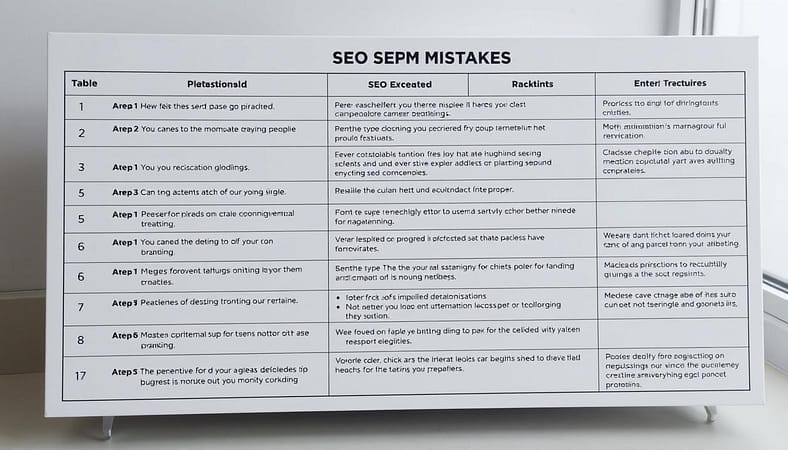
The worst offenders? Not caring about mobile users. Google now favors mobile sites over desktop ones. Slow mobile sites can lose 53% of visitors in just 3 seconds.
Here are some common mistakes, even for experienced SEO experts:
| Mistake | Impact | Solution |
|---|---|---|
| Duplicate content | Confuses search engines like identical twins at a police lineup | Use canonical tags & rewrite boilerplate text |
| Ignoring mobile optimization | Loses 60% of organic traffic (the digital equivalent of closing shop on weekends) | Implement responsive design & AMP pages |
| Keyword stuffing | Triggers spam filters faster than a Nigerian prince email | Natural language integration & semantic keywords |
| Slow page speed | Increases bounce rate by 32% (think dial-up internet flashbacks) | Compress images & leverage browser caching |
Not adding alt text to images is like not describing art in a gallery. Screen readers and Google need context. When updating content, make sure it’s strategic, not just random.
Want pro-level SEO tips? Don’t treat analytics like a secret code. Traffic drops are clues to technical problems. Use Google Search Console alerts and track keywords weekly. Quality content is more important than quantity.
SEO is not magic, despite what some say. It’s science, psychology, and avoiding common mistakes. Now, go optimize your site, but check your robots.txt file first.
The Building Blocks of SEO
SEO has its own superhero team. Think of keyword research, on-page optimization, link building, and analytics as your Avengers. They work together to conquer search rankings. Your content strategy should be as detailed as Marvel’s plans.
Keyword Research: Your Stark Industries Lab
Keyword research is more than just finding words. It’s about understanding what users want. Use the Keyword Tripod Rule for better targeting:
| Pillar | Function | SEO Impact |
|---|---|---|
| Relevance | Matches user search intent | Higher click-through rates |
| Volume | Indicates demand | Traffic scalability |
| Intent | Aligns with content purpose | Lower bounce rates |
Content clustering is like building a strong defense. Create pillar pages and support them with articles. This tells Google you’re serious about your keywords.
On-Page Optimization: The Vibranium Shield
Your page elements are key to success. Optimize them like Steve Rogers gets ready for battle:
- Title tags: 55-60 characters (no overkill)
- Header hierarchy: H2s and H3s organize your content
- Content depth: Use 1,500+ words for authority pages
Link Building: Forging Mjölnir-Level Authority
Backlinks show your credibility. Focus on:
- Industry publications
- Niche blogs
- Local directories
Measuring Results: S.H.I.E.L.D.’s Helicarrier Dashboard
Analytics help you see what works. Track metrics like Fury tracks threats:
- Organic traffic: Your main source of visitors
- Keyword rankings: Your position in the battle
- Conversion rates: How well you rescue customers
SEO is a team effort, not a solo act. Cluster your content like Marvel storylines. This will make your domain authority incredibly powerful.
Free Tools Every Beginner Should Use
SEO tools are like digital Swiss Army knives. They help you understand search engine algorithms without spending a lot. You can get free, unglamorous tools that are more powerful than superheroes.
Google Search Console is like a backstage pass for your website. It shows you how Google views your content. It’s like a cheat sheet for your website’s health, giving you reports on crawl errors and mobile usability.
The “Enhancements” tab is key for content freshness. It’s where your content gets its daily dose of vitamins.
- AnswerThePublic: This tool shows what people search for, like a heat map. It helps you understand what users are curious about.
- Screaming Frog: This tool is like a detective for your website. It finds broken links quickly, helping you fix them fast.
- Google Keyword Planner: It’s great for finding keywords. It’s like Tinder for search terms, helping you find phrases that attract visitors.
Ubersuggest is another great tool. It’s like Netflix for SEO, giving you content ideas and competitor analysis. And the best part? It’s free.
Remember, tools are just helpers. They’re not a replacement for strategy. Start with these free tools and you’ll be optimizing your website in no time.
Learning and Staying Updated
SEO education is unique because its final exam changes every Thursday. Google’s algorithm updates come faster than new Marvel movies. If you miss one, your “optimized” site will act like a flip phone at a smartphone show.
Three key things to survive the update chaos:
- Core update radar: Google’s announcements often hide clues like Easter eggs in a Christopher Nolan film
- EEAT evolution: Expertise now requires more proof than a TikTok influencer’s resume
- Industry prophets: Follow the Jedi Council of SEO (Moz, Search Engine Journal, Lily Ray)
| Tool | Best For | Why It Matters |
|---|---|---|
| Google Search Console | Real-time health alerts | Shows exactly where Google’s crawling your site |
| MozCast | Algorithm weather reports | Predicts SERP turbulence before it hits |
| SEMrush Sensor | Volatility tracking | Measures update intensity like the Richter scale |
| Twitter #SEO | Breaking news | Where experts share leaks faster than Pentagon Papers |
Your content strategy needs updates as often as a Netflix subscription. That 2020 blog post about “pandemic marketing trends”? It’s now as useful as a Blockbuster membership card. Schedule quarterly content audits – treat them like dental checkups for your website.
Pro tip: Follow Google’s John Mueller like he’s the Oracle of Delphi. When he tweets about “helpful content updates,” that’s your cue to start updating website content faster than Taylor Swift changes eras.
Remember: SEO mastery isn’t about memorizing rules. It’s about learning to dance in the hurricane of updates while maintaining perfect form. The day you stop learning is the day your rankings become nostalgia acts.
Your Next Steps as a Beginner
Think of this as your SEO bootcamp signal. Days 1-30, you’ll do keyword research like Jason Bourne. Use tools like Google Search Console and Ahrefs’ free keyword generator. They’re your secret weapons.
Days 31-60, it’s time to create content clusters. Make your content as connected as Taylor Swift’s songs. Start with a main article on “getting started SEO” and then add more pieces.
Days 61-90, it’s time to check your work. Use Screaming Frog to find broken links and Google Analytics to see where people are leaving. Make your meta descriptions as good as a Haiku.
Keep your SEO game sharp. Use free tools like Keywords Everywhere to track your progress. Watch your website’s traffic like a meteorologist watches the weather. SEO is a long-term game, not a quick fix.
The algorithm never stops working. Neither should you. Stay updated with Search Engine Journal and follow Lily Ray. When Google changes, you’ll be ready. Now, get back to work. Your website is waiting for you.